

 Email
Email Print
Print  Bookmark
For most of the last few years, the Utica story has been about discipline: fewer rigs, fewer headlines, and steady execution from a handful of operators who know exactly what they have. Ascent's latest investor presentation suggests something more specific is happening beneath the surface. In their view, the company is not just participating in the Utica - it is increasingly defining the top end of the basin's performance curve.
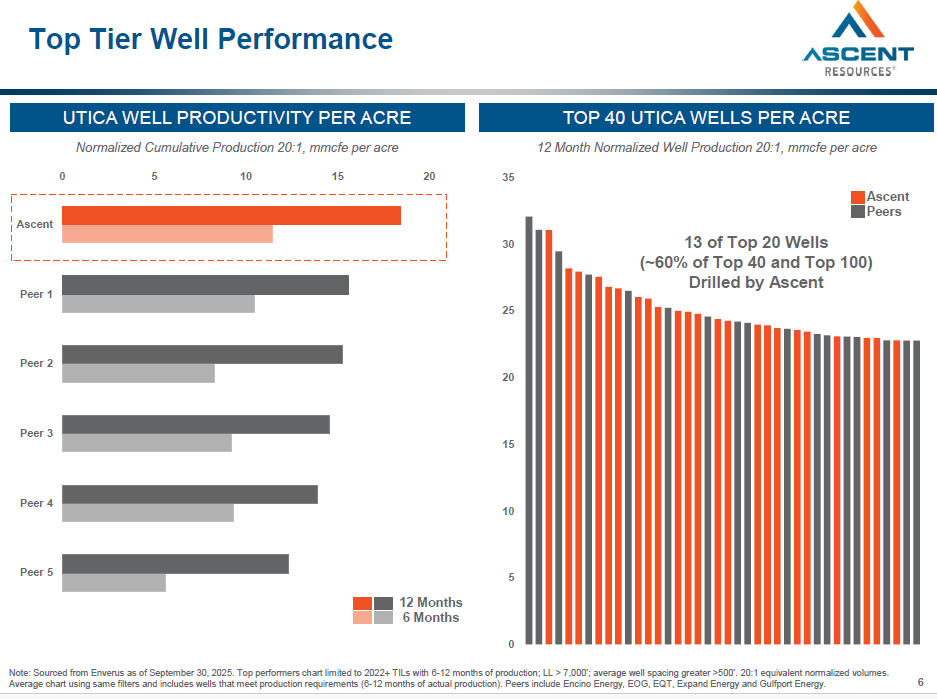
Ascent makes a bold claim: using a standardized Enverus-filtered dataset (2022+ TILs, 6-12 months of production, laterals greater than 7,000 feet, and spacing over 500 feet), Ascent says it drilled 13 of the Top 20 Utica wells, and roughly 60% of the Top 40 and Top 100 wells under the same criteria. Executives will rightly treat any "Top X wells" framing as marketing until proven out across time and commodity cycles, but the signal is still meaningful. Ascent is telling the market it believes its Utica program sits at the very top of current Appalachia performance.
The next slides give the "why." The deck pairs well-performance positioning with operational execution metrics that have become the true currency of shale competitiveness: cycle time, completion efficiency, and cost per lateral foot.
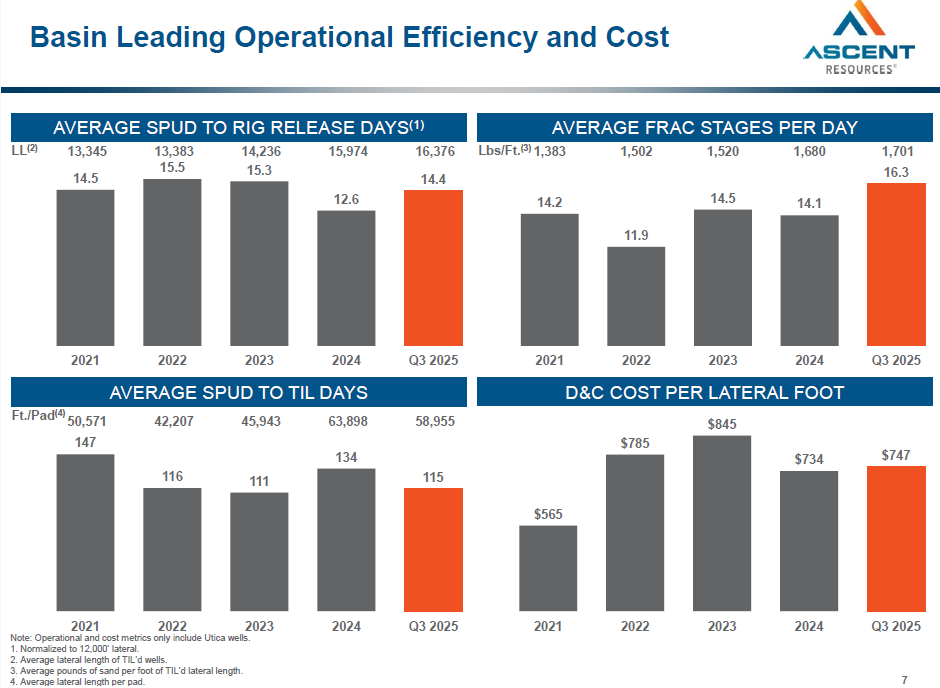
Ascent highlights basin-leading operational efficiency and cost trends across its Utica wells. This is the part of the story that tends to show up first in results, then later in broader activity: better repeatability, tighter cycle times, and more output per unit of effort. If the well results are the headline, the efficiency metrics are the foundation.
But the most interesting line in the presentation is not a chart - it is a geographic statement: "Encouraging Noble County results." Ascent positions Noble as a driver that is actively high grading its inventory.
For Appalachia watchers, this is the kind of detail that matters. It suggests the Utica is not a static, mature play where performance is fully understood, but a basin where marginal geographies can still improve the inventory narrative. If Noble continues to validate, it does not just add locations - it adds confidence around future development optionality and capital allocation.
That inventory story ties directly into the final piece of the deck: Ascent's continued push into long laterals. The company points to expected 2025 average lateral lengths around 17,000 feet, supported by a contiguous acreage position that enables development at scale. Guidance implies a sustained, repeatable cadence: 50-55 wells spud in 2025 with laterals in the 16,750 to 17,250 foot range.
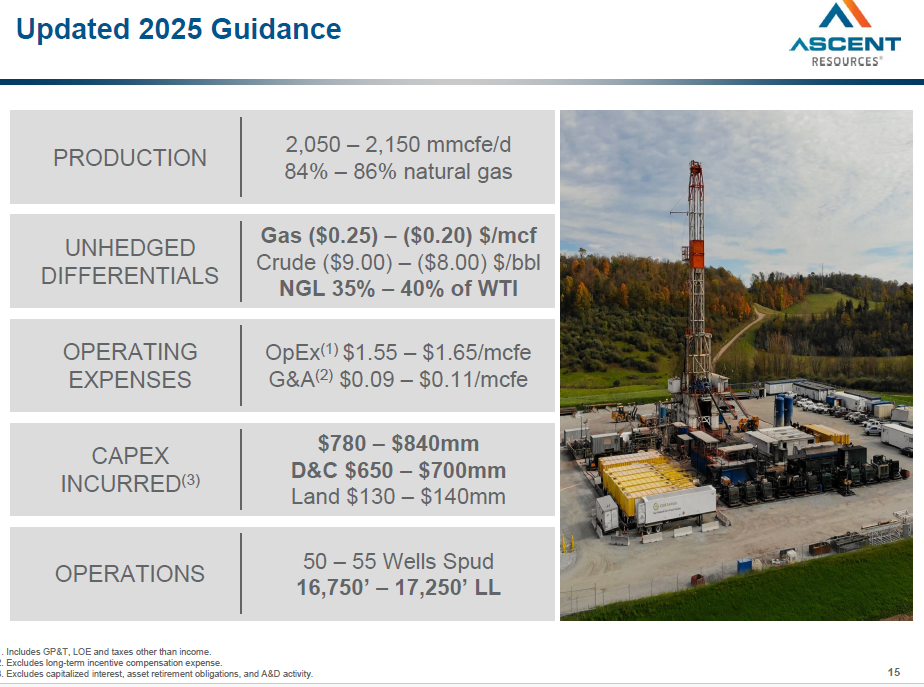
The message is straightforward: in Appalachia, the best operators win by turning acreage contiguity into lateral length, lateral length into cost efficiency, and cost efficiency into durable well economics. Ascent is telling the market it has the acreage and execution machine to keep pushing that flywheel.
What this means for the basin
If Ascent's view is directionally correct, the Utica remains a quiet source of premium well results even in a capital-disciplined world. And if Noble County continues to surprise to the upside, the next chapter of the Utica may be less about holding the line and more about selectively expanding the set of truly economic rock.
What to watch next quarter
-
Do Noble County wells hold up as lateral lengths stay long and development scales?
-
Do cycle times and cost-per-foot remain stable as the program runs at a steady cadence?
-
Does Ascent's share of top-tier wells persist as more 2024-2025 vintages mature?
Related Categories :
Private Equity
More Private Equity News
-
Ascent Resources 2026: A Quiet Growth Story for Oilfield Services
-
Mitsubishi to Buy Aethon for ~$5.2B, Taking Scaled Haynesville Gas Platform
-
Silver Hill Expands South Texas Footprint with Acquisition of 1776 Energy Assets
-
Chevron, Quantum prepare joint bid for Lukoil’s international assets
-
Kimmeridge Offers $6 Billion for Ascent Resources: A Bid Lands in the Middle of a High-Stakes Sponsor Dispute
Northeast News >>>
-
Why $90 Oil Isn’t Bringing Back the Rigs -


-
Q1 A&D Transactions Jump to $30B , While Deal Flow Was Down 40%

-
Ascent Resources 2026: A Quiet Growth Story for Oilfield Services

-
Infinity Closes $1.2B Utica Upstream & Midstream Deal

-
Antero Resources Completes $2.8B Marcellus Expansion
